3. What is the company saying about the ethical situation? How are they explaining their actions, their lack of action, or their reaction? What do you think about their approach to the issue or problem? You might want to examine interviews, press releases and other materials in answering these questions.
When Nestle was asked if they consider moving their water bottling site to another location, outside of California, their response was no. Nestle CEO Tim Brown response was: “Absolutely not. In fact, if I could increase [water bottling operations], I would” (Dangelantonio, 2015). Nestle believes that they are second largest bottler in the state and that if they were to stop production people would just purchase a different brand of bottled water. Brown stated that the water bottling production in California is “driven by consumer demand, it’s driven by an on-the-go society that needs to hydrate. Frankly, we’re very happy [consumers] are doing it in a healthier way” (Dangelantonio, 2015). The healthier ways are meant as in people choosing water over sodas and juices, not the healthier way for the environment. The plastic bottles that are being manufactured and promoted are single use plastic that litter and damage our world and its inhibitors, us included.
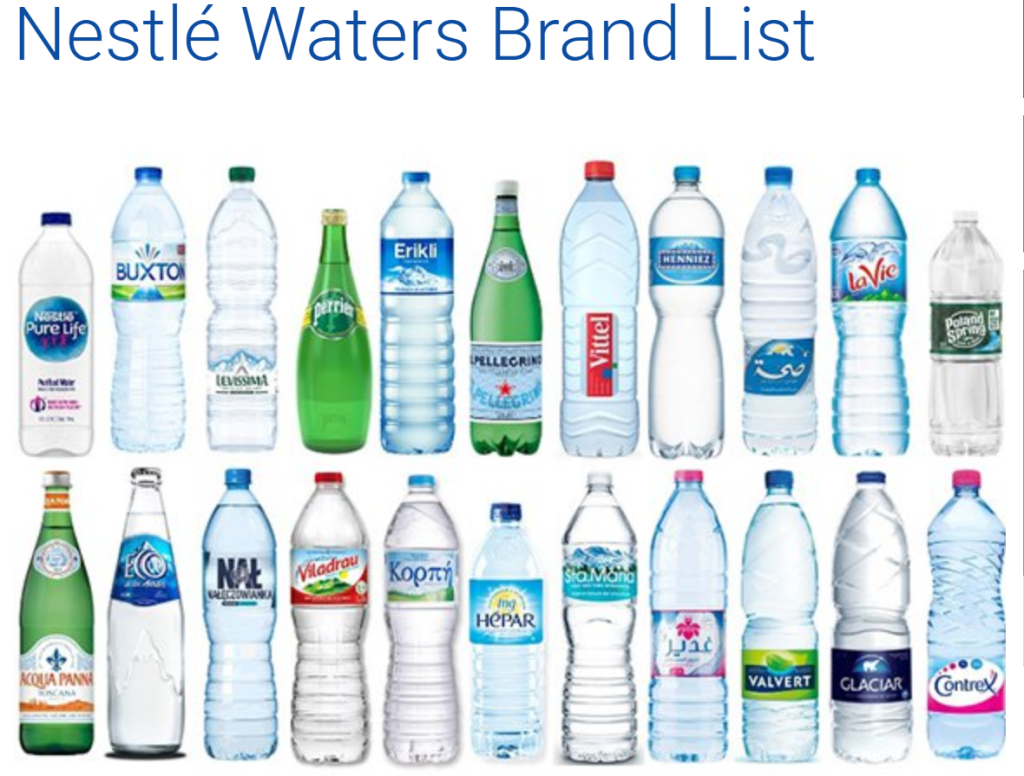
Brown believes water is a right and not a need. In 2000, Nestle pushed the World’s Water Council to make drinking water a need instead of a right. “If water were a right, then it would have to be supplied freely, but since it’s a need, water companies can sell it for as much as they want and make an enormous profit” (O’Callaghan, 2019). According to The Sun, Nestle also believes that bottles water is not the cause nor contributing to the California drought. Nestle tries to justify the amount of water they are taking by stating that they use “a total of 705 million gallons of water per year… [which] is roughly equal to the annual average watering needs of two California golf courses” (The Sun, 2015).
Due to the back lash, Nestle announced that they invested $7 million on technology to upgrade equipment to be eco-friendlier. For example, they are investing in what they call “zero water” to reuse and recycle water that is used to keep milk cool in the milk storage towers. The water used to go into the waste stream, but now with the new technology, the water can be reused for other purposes. Nestle is hoping that this investment changes people’s mind about their water and that the company is being environmentally conscious.
However, overall I find that Nestlé’s approach to bottling water is still ethically wrong. Nestles approach is to find locations that are economically struggling, offer potential jobs and support to the community, and then receive extremely inexpensive permits. Nestle then sells that water for a larger profit and people feel like they are essentially taking the people’s water and selling it even though it should be free and belong to the people, not Nestle. The streams near and around the water source have become smaller and some no longer exist. This then negatively affects the eco system of plants, animals, and us humans.
Source:
Andrei, M. (2020, January 28). Why Nestle is one of the most hated companies in the world. Retrieved March 27, 2020, from https://www.zmescience.com/science/nestle-company-pollution-children/
Dangelantonio, M. (2015, May 13). Nestlé Waters CEO isn’t stopping bottling in California, says new tech will save millions of gallons. Retrieved March 27, 2020, from https://www.scpr.org/programs/airtalk/2015/05/13/42830/nestl-waters-ceo-isnt-stopping-bottling-in-califor/
O’Callaghan, K. (2019, April 24). Nestle: the world’s most corrupt corporation. Retrieved March 27, 2020, from https://skierscribbler.com/7671/opinion/nestle-the-worlds-most-corrupt-corporation/
The Sun (2015, April 28). Nestlé Waters: Bottled water is not contributing to California’s drought. Retrieved March 27, 2020, from https://www.sbsun.com/2015/04/28/nestl-waters-bottled-water-is-not-contributing-to-californias-drought/
 Sidney Ponikau
Wow, this is an ethical situation for sure. To be honest it just seems like Nestle is being selfish in this predicament. Brown believes water is a right and not a need which was a quote stated above that was very interesting as well. Nestle’s objective is to make money off of their water and not care about anything else including the environment. This negatively affects the Eco system that involves plants, animals and even humans which is a huge red flag overall.
LikeLike
I agree, I also think Nestle is being selfish and only looking at the profit they are making, not the process. Their whole history of ethical issues are huge red flags.
LikeLike
I agree and disagree with what you are saying. I do agree that what Nestle is doing at the moment is bad for the environment, but also he isn’t wrong. I personally drink about 4 water bottles a day and it is a need for me. I never drink tap water and don’t plan on starting. I believe it is an ethical situation because obviously everyone has their own opinions and have different views on this situation. In their mission statement they are assuring that they help the environment as well.Yes, they are taking water from the environment, but it does all come back. The earth produces water.
LikeLike
With bottled water is not only the problem of mining the water, but also the single use plastic. Only 8.4% of plastic is actually getting recycled. I also agree, drinking water is better than soda or juices, but not in single use plastic water bottles.
LikeLike
Madison makes good points with her comments. While I don’t drink bottled water, I do drink filtered water. I think it is important that Nestle focuses on what the consumer wants more than what the company wants. While that might have negative impacts on the environment, it is crucial for the companies success. Looking at the comments made by Nestle about the situation, I realize that their main goal is internal success. Simply saying “no” when asked if they would stop bottling water in California will show to have a negative impact on the company. I think there are much better ways that the company could have addressed the situation than simply saying “no”.
LikeLike
I agree. I also drink filtered water and carry a reusable water bottle everywhere. And yes, I personally think Nestle needs to rethink their whole approach on the water bottling service they provide.
LikeLike
I find Nestle trying to make water a need instead of a right disturbing. Water is a right and always should be, otherwise people are going to die of dehydration. To put peoples health at risk for profit is despicable.
LikeLike
It really upsets me that Nestle is so focused on the money profit and not the way they are making the profit.
LikeLike